Chinese cuisine comprises cuisines originating from China, as well as from Chinese people from other parts of the world. Chinese food staples such as rice, soy sauce, noodles, tea, chili oil, and tofu, and utensils such as chopsticks and the wok, can now be found worldwide.
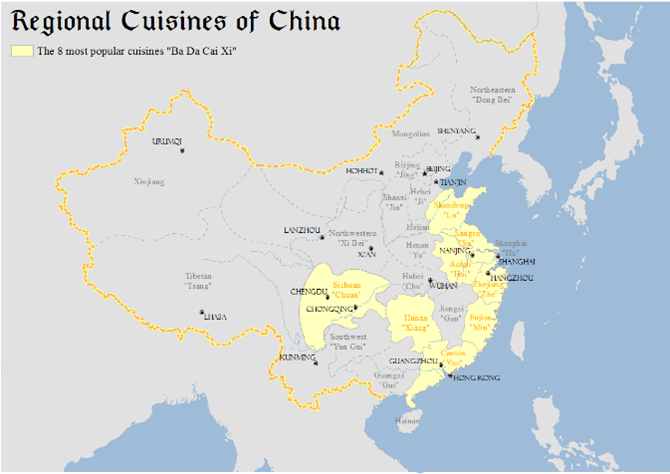
The preferences for seasoning and cooking techniques of Chinese provinces depend on differences in social class, religion, historical background, and ethnic groups. Geographic features including mountains, rivers, forests, and deserts also have a strong effect on the local available ingredients, considering that the climate of China varies from tropical in the south to subarctic in the northeast. There are numerous regional, religious, and ethnic styles of Chinese cuisine found within China and abroad. In 1980, a modern grouping from Chinese journalist Wang Shaoquan's article published in the People's Daily newspaper identified the Eight Cuisines of China as Anhui (徽菜; Huīcài), Guangdong (粵菜; Yuècài), Fujian (閩菜; Mǐncài), Hunan (湘菜; Xiāngcài), Jiangsu (蘇菜; Sūcài), Shandong (魯菜; Lǔcài), Sichuan (川菜; Chuāncài), and Zhejiang (浙菜; Zhècài)
The introduction of Chinese food in Chinese from the baidu
History
Chinese food culture initially centered around the North China Plain. The first domesticated crops seem to have been the foxtail and broomcorn varieties of millet, while rice was cultivated in the south. By 2000 BC, wheat had arrived from western Asia. That time, grain was stored against famine and flood and meat was preserved with salt, vinegar, curing, and fermenting. The flavor of the meat was enhanced by cooking it in animal fats though this practice was mostly restricted to the wealthy. During Shi Huangdi's Qin dynasty, the empire expanded into the south. By the time of the Han dynasty, the different regions and cuisines of China's people were linked by major canals and leading to greater complexity in the different regional cuisines. The great migration of Chinese people south during the invasions preceding and during the Song dynasty increased the relative importance of southern Chinese staples such as rice and congee. The Yuan and Qing dynasties introduced Mongolian and Manchu cuisine, warm northern dishes that popularized hot pot cooking. And all these form the modern Chinese food.
Picture of the Food History
Line Picture Referring to the Chinese Food History
The Three Cuisine
The three cuisine here I am talking about are Anhui(Hui) cuisine (徽菜; Huīcài), Szechuan(Chuan) cuisine (川菜; Chuāncài), Hunan(Xiang) cuisine (湘菜; Xiāngcài). From the graph we can clearly tell that the three provinces (matching the three cuisine) have no cost line. The aim of this website is to introduce you this three type of cuisine, which are vary famous in China and abroad. The geographical features greatly differ from the other five province, the three provinces geographical features also varies in different kinds , and that just form the uniqueness of the dishes.
Picture of the Eight Cuisine shown on the Chinese Map