Detail information of the three cuisine

Hui Cuisine

Brief Information

Anhui cuisine is known for its use of wild herbs, from both the land and the sea, and simple methods of preparation. Braising and stewing are common cooking techniques. Frying and stir frying are used much less frequently in Anhui cuisine than in other Chinese culinary traditions. Anhui has ample uncultivated fields and forests, so the wild herbs used in the region's cuisine are readily available. Anhui cuisine is heavily associated with tofu, with Chinese folklore crediting the creation of tofu to the Han dynasty prince Liu An who hailed from Shou County (dubbed the "hometown of tofu"). Anhui is the home of hairy tofu where it is a popular snack.

History

Anhui cuisine history can be dated to Song Dynasty (960 - 1279 AD). Hui is the short name for Huizhou, an ancient area in southern Anhui province, where Anhui cuisine originated from. The banquets after worship ceremonies were very popular there, which were considered the origin of Hui cuisine. The development of Hui cuisine is closely related to the Huizhou merchants. As merchants from Huizhou did business around China, Anhui cuisine was introduced all over the country too and reached its peak in Qing Dynasty (1644 - 1911 AD).
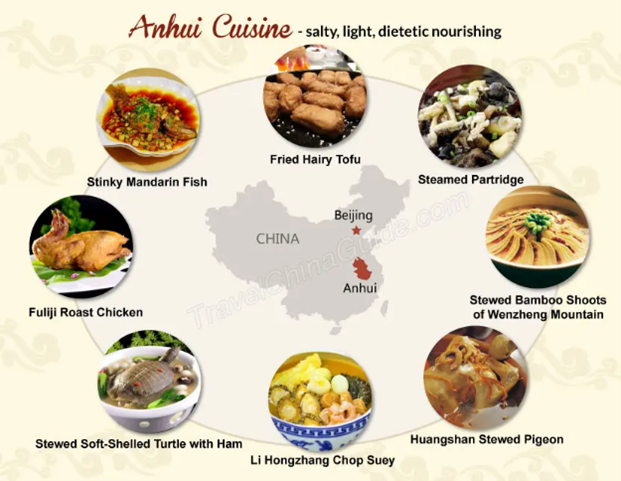
the location of Anhui on the map
The location of Anhui provience

Chuan Cuisine

Brief Information

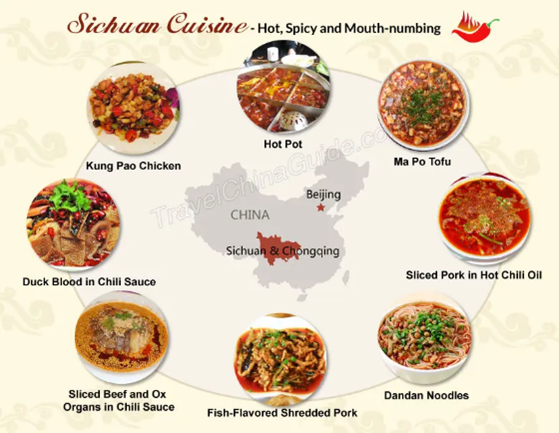
Chuan cuisine is a style of Chinese cuisine originating from Sichuan province and the neighboring Chongqing municipality. There are many regional, local variations of Sichuanese cuisine within Sichuan and Chongqing. It has bold flavours, particularly the pungency and spiciness resulting from liberal use of garlic and chili peppers, as well as the unique flavour of Sichuan pepper. Some examples are Kung Pao chicken and Yuxiang shredded pork. Four sub-styles of Sichuan cuisine include Chongqing, Chengdu, Zigong and Buddhist vegetarian style.

UNESCO declared Chengdu, the capital of Sichuan Province, to be a city of gastronomy in 2011 to recognise the sophistication of its cooking.

History

Since the 16th century, the list of major crops in Sichuan has even been lengthened by New World newcomers. The characteristic chili pepper came from Mexico, but probably overland from India or by river from Macau, complementing the traditional Sichuan peppercorn (花椒; huājiāo).

Sichuan is colloquially known as the "heavenly country" due to its abundance of food and natural resources. One ancient Chinese account declared that the "people of Sichuan uphold good flavour, and they are fond of hot and spicy taste." Most Sichuan dishes are spicy, although a typical meal includes non-spicy dishes to cool the palate.

The superior natural resources of Sichuan Province provided plenty natural resources for the development of cooking. The flow of the Yangtze river through Sichuan Province provided nutrients for fundamental foods, and a source of water.

the location of Sichuan on the map
The location of Sichuan provience

Xiang Cuisine

Brief Information

Xiang cuisine, also known as Hunan cuisine, consists of the cuisines of the Xiang River region, Dongting Lake and western Hunan Province in China. It is one of the Eight Great Traditions of Chinese cuisine and is well known for its hot and spicy flavours,[1] fresh aroma and deep colours. Despite this, only about 20% of the cuisine uses capsicum to produce a strong spicy taste.[2] Common cooking techniques include stewing, frying, pot-roasting, braising and smoking. Due to the high agricultural output of the region, ingredients for Hunan dishes are many and varied.

History

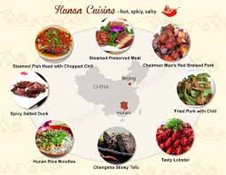
History of the cooking skills employed in Hunan cuisine dates back to the 17th century.[1] The first mention of chili peppers in local gazettes in the province date to 1684, 21st year of the Kangxi Emperor.[3] During the course of its history, Hunan cuisine assimilated a variety of local forms, eventually evolving into its own style. Some well-known dishes include fried chicken with Sichuan spicy sauce (麻辣鸡丁; 麻辣雞丁; málà jīdīng) and smoked pork with dried long green beans (干豆角蒸腊肉; 干豆角蒸臘肉; gāndòujiǎo zhēng làròu).

the location of Hunan on the map
The location of Hunan provience

Sources